

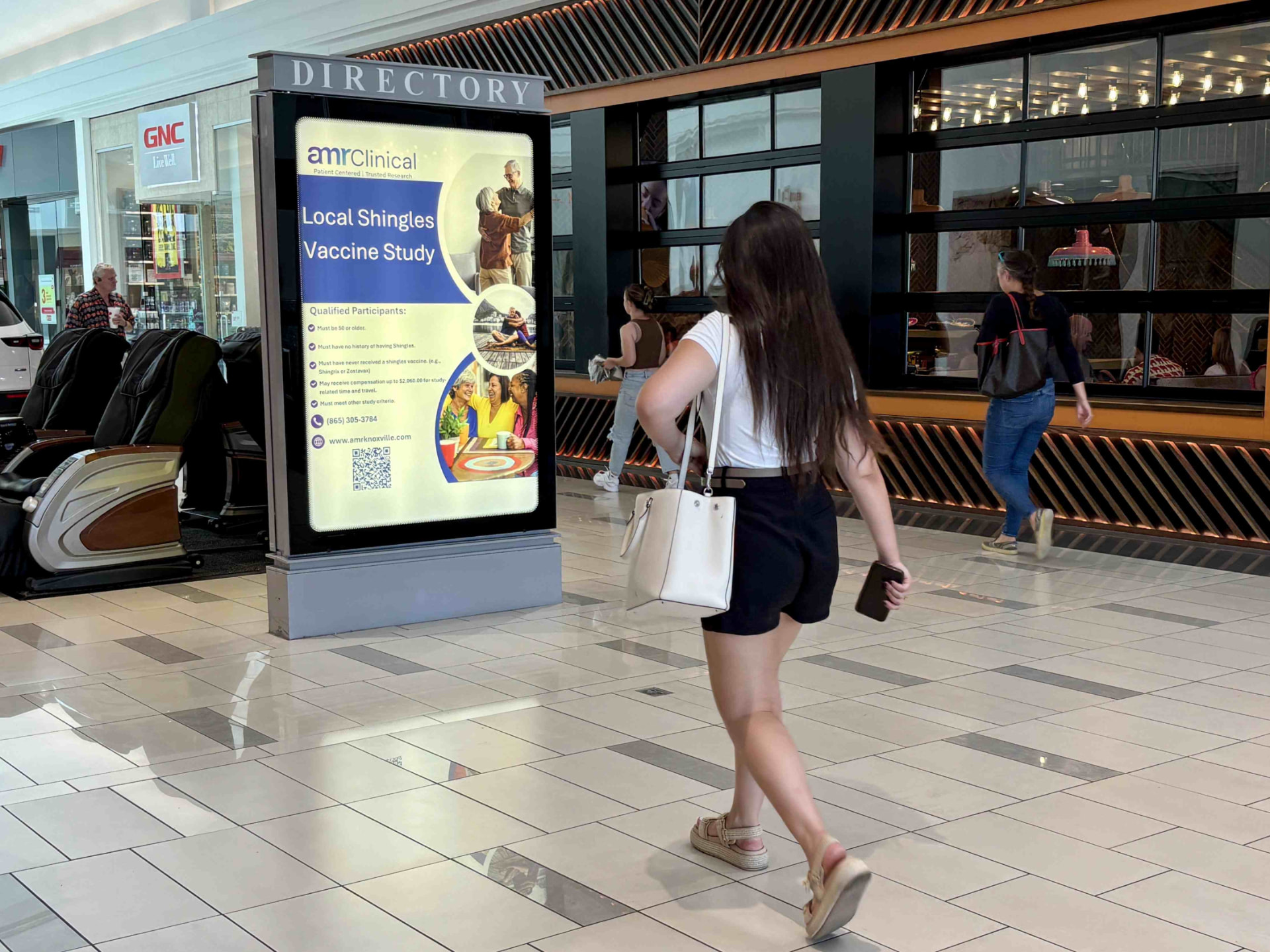
Government agencies and public health departments face a distribution problem that most advertisers do not: their audience is not defined by purchase intent but by geography, and they often need to reach nearly everyone in a community rather than a specific segment. Shopping centers, which draw a broad cross-section of local residents, are one of the more efficient ways to reach that kind of general public audience.
This article covers how public agencies use mall advertising for census outreach, health campaigns, and civic information, along with the practical and compliance considerations specific to government messaging.
Why broad-reach media suits public messaging
Public health and civic campaigns often need to reach people regardless of age, income, or shopping habits, which makes narrowly targeted digital advertising less efficient than it is for a commercial product. A shopping center's audience naturally spans age groups, income levels, and languages within a community, making it closer to a true cross-section than most other advertising environments.
Repetition also matters more in public messaging than in retail advertising, since behavior change or awareness on issues like vaccination, voting, or safety often requires multiple exposures over time rather than a single glance.
Common government and public health uses
Census participation drives, voter registration deadlines, public health campaigns around vaccination or screening, and emergency preparedness messaging are among the most common uses of mall advertising by public agencies. Local government also uses this channel for civic announcements such as service changes, public meetings, and utility information.
- Census and voter registration awareness campaigns
- Vaccination and public health screening promotion
- Emergency preparedness and safety information
- Civic service announcements and public meeting notices
Formats for public messaging
Digital screens near entrances allow public agencies to update messaging as deadlines approach or circumstances change, which is valuable for time-sensitive campaigns like registration deadlines or emerging health guidance. Static formats such as banners and column wraps work well for longer-running general awareness messages that do not need frequent updates.
Multilingual messaging deserves particular attention in this category, since public information campaigns often need to reach residents who are not primarily English speaking, and shopping centers in diverse communities are well suited to displaying messages in more than one language.
Procurement and compliance considerations
Government advertising often moves through a procurement process distinct from commercial advertising purchases, involving competitive bidding or approved vendor lists depending on the agency and jurisdiction. Building extra lead time for procurement approval into the campaign timeline avoids the common problem of a deadline-driven message missing its window because the purchase process took longer than expected.
Public agencies should also confirm that messaging meets any required accessibility standards and that claims, particularly in health messaging, are consistent with current official guidance at the time of production.
Working with property management
Many properties have experience working with local government and are familiar with the procurement and approval requirements involved, which can smooth the process. Some properties also offer reduced rates or donated space for certain public service campaigns, which is worth discussing directly during initial conversations.
Measuring public campaigns
Track a campaign-specific outcome where possible, such as registration numbers, screening appointments, or website traffic to a dedicated page tied to the campaign, and compare against a similar period or comparable market without the placement. For general awareness campaigns without a direct action, surveys measuring recall before and after the flight can provide a useful proxy for impact.
Frequently asked questions
Can government agencies advertise in shopping centers?
Yes. Many properties regularly work with local, state, and federal agencies on public information campaigns.
Does government advertising require a different purchase process?
Often yes, since public agencies may follow a procurement process involving bidding or approved vendor lists depending on the jurisdiction.
Are discounted rates available for public health campaigns?
Some properties offer reduced rates or donated space for certain public service messaging, though this varies by location.
How can multilingual communities be reached effectively?
Malls serving diverse communities can often display messaging in multiple languages, which is worth planning into creative production early.
Sources
- CDC public health communication resources
- U.S. Census Bureau retail trade data
- FTC advertising and marketing rules
- ICSC shopping center industry research
- Pew Research Center
Related reading
MallAds.com helps advertisers turn government public health mall advertising research into a practical media plan, with placement support across more than 1,700 malls and billboard markets nationwide.