

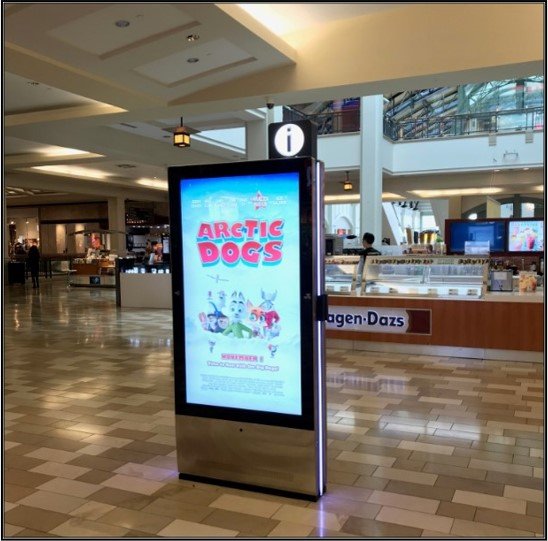
Digital out of home, usually shortened to DOOH, is advertising on screens in public spaces: shopping centers, transit stations, airports, roadside digital billboards, gyms, and office buildings. It is the fastest-growing part of out-of-home advertising, and for good reason.
This article explains what DOOH actually is, how buying it differs from buying printed media, and where it fits in a media plan.
The basic definition
DOOH is any out-of-home advertising delivered on a digital display rather than a printed surface. The defining features are that the creative can be changed remotely, several advertisers can share the same physical unit, and the schedule can vary by time of day.
Everything else, including the audience, the location logic, and the creative discipline, carries over from traditional out-of-home.
How DOOH is bought
There are three common buying models, and most advertisers encounter all of them at some point.
- Direct buys from the media owner for specific screens and flights
- Package buys across a network of screens in one property or market
- Programmatic buys through a demand-side platform, priced per thousand impressions
- Sponsorships where one advertiser takes the full loop for a period
- Hybrid deals combining guaranteed placement with flexible overflow inventory
Loops, slots, and share of voice
On a shared screen, advertisers occupy a slot in a repeating loop. If the loop is ninety seconds and your slot is ten seconds, you own roughly eleven percent of the screen's time. That share of voice is the single most important number in a DOOH proposal and the one most often left out.
Always ask for loop length and the number of advertisers before comparing two DOOH offers on price.
What DOOH does better than static
Speed, flexibility, and relevance. Creative can launch in days, change mid-flight, and adapt to the time of day, the weather, or an external data trigger such as a sports result or a pollen count.
It also removes production and installation cost from the equation, which changes the economics of short flights significantly.
What static still does better
Exclusivity and permanence. A printed banner is yours for the entire flight, always on, never sharing the surface. For brand-building where constant presence matters more than message flexibility, static often delivers more value per dollar.
The strongest plans combine the two rather than treating the choice as either-or.
Measurement in DOOH
DOOH inherits impression methodologies from out-of-home measurement bodies, based on traffic counts, visibility modelling, and increasingly on anonymised mobile location data. It is not the same as a click, and it should not be evaluated as if it were.
Practical measurement usually means comparing a market with DOOH against one without, watching branded search and store visits, or using a scannable code for a direct-response signal.
Frequently asked questions
Is DOOH more expensive than static?
Per unit of time, often yes, but with no production cost and shorter minimum flights the total campaign cost can be lower.
Can DOOH be bought programmatically?
Yes, much of the inventory is available programmatically, though premium placements are still frequently sold direct.
Do DOOH screens have sound?
In malls, almost never. Design for a silent viewing environment.
How is a DOOH impression counted?
Through audited traffic and visibility models rather than device-level tracking, which is why the figures are estimates rather than exact counts.
Sources
- DPAA digital out of home industry resources
- Out of Home Advertising Association of America
- Geopath OOH audience measurement
- IAB digital advertising standards
- Statista out of home advertising statistics
Related reading
Ready to apply these strategy insights? MallAds.com brings more than 20 years of shopping-center and billboard experience to campaigns built around your market, audience, and budget.