

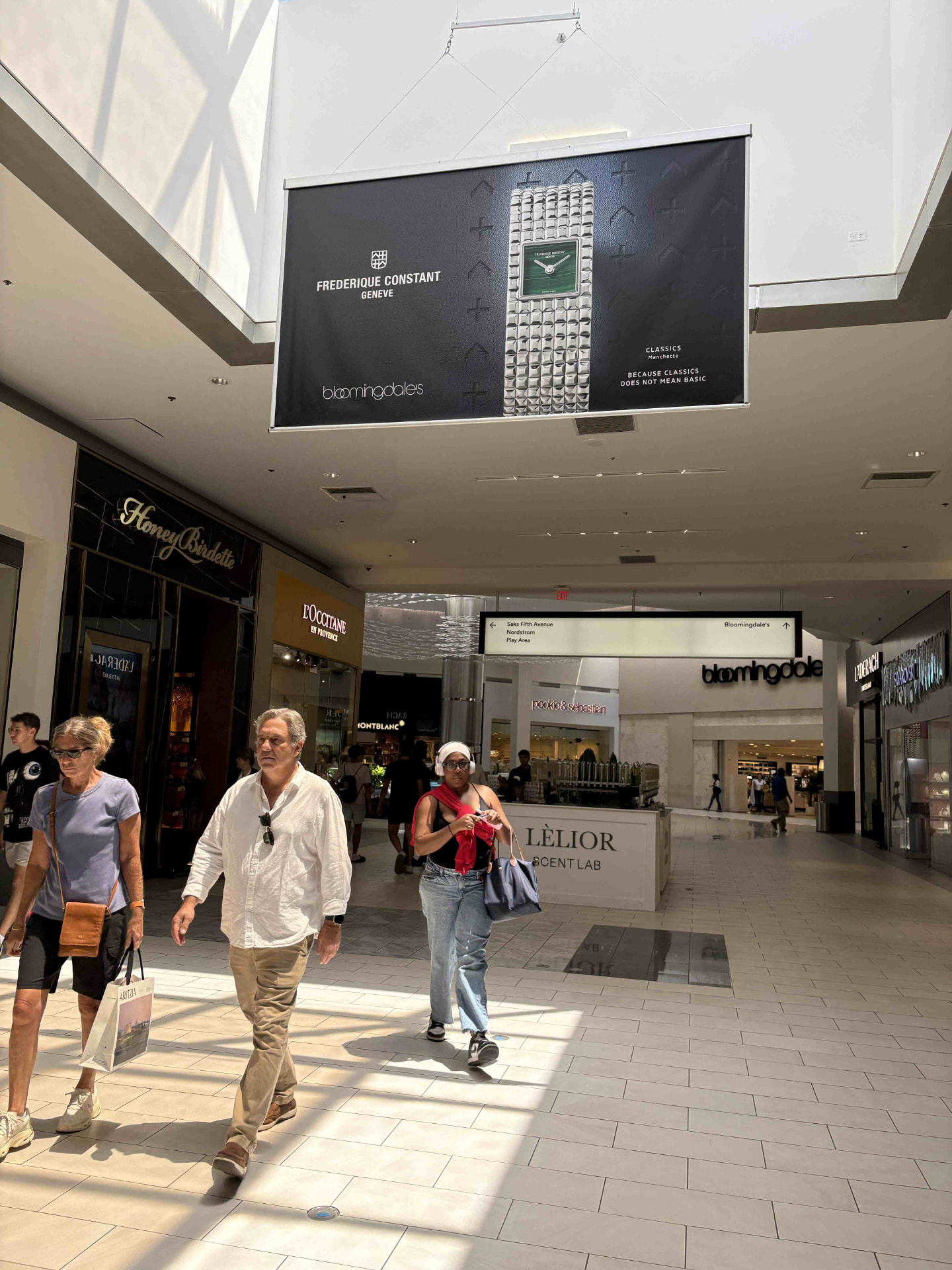
A standee is a freestanding display placed directly in the shopper's path. Unlike a wall-mounted panel, it occupies physical space, which is exactly why it works: shoppers must acknowledge it, walk around it, and in the process read it.
This article covers where standees perform, how they differ from other floor-level formats, and how brands use them to bridge advertising and merchandising.
What a standee can do that a panel cannot
Standees are three-dimensional. They can hold product, house a screen, carry a takeaway, or shape themselves around a brand icon. That physical presence gives them stopping power out of proportion to their size.
They are also mobile. A standee can be repositioned within a property as traffic patterns shift, or moved between centers across a multi-market campaign, which spreads production cost across more exposure.
Where standees earn their keep
Placement drives everything. The unit needs to sit where shoppers naturally slow: near seating, at a court, outside an anchor entrance, or adjacent to a store the campaign supports.
- Center court and seating areas where dwell is longest
- Just outside a partner retailer to drive in-store conversion
- Near entrances where shoppers orient themselves
- Beside escalator landings on upper levels
- Alongside an event or activation footprint
Design and construction
Standees are printed on rigid substrate, often with a weighted base for stability, and must meet the property's fire rating and footprint rules. Anything that could tip or obstruct egress will be refused, so dimensions are agreed with the center before production.
Design should read from both the approach and the side. A single-face standee wastes half its audience in a two-way concourse.
Standees and product display
The most effective standees do more than advertise. A watch brand that shows the actual product behind an acrylic front, a telecom that mounts a live handset, or a university that holds brochures turns a piece of media into a small retail moment.
When product is involved, coordinate with the center on security requirements, since anything reachable needs either supervision or a locked enclosure.
Cost profile
Media rates for standee placement are modest; the investment sits in fabrication. Because a well-built standee travels between centers and survives many flights, the effective cost per exposure falls sharply on multi-market campaigns.
When to use a standee
Choose a standee when the message benefits from physical presence: a product launch, a service demonstration, a recruiting drive with take-home materials, or any campaign where you want shoppers to interact rather than just look.
Frequently asked questions
Can a standee hold a screen?
Yes. Many are built with an integrated display, which combines the physical presence of a standee with the flexibility of digital creative.
Who moves the standee between locations?
The property or an approved vendor handles placement. Never reposition a unit yourself without approval.
Do standees need to be staffed?
Not usually. Staffing turns a standee into an activation, which is a different and more expensive kind of buy.
How long does fabrication take?
Plan for several weeks between approved design and delivery, longer if the unit includes product housing or electronics.
Sources
- ICSC shopping center industry research
- National Retail Federation research
- Out of Home Advertising Association of America
- Nielsen advertising research
- Statista out of home advertising statistics
Related reading
Use this standee advertising guidance as a starting point, then ask MallAds.com to confirm current locations, formats, timing, and pricing for your campaign.