

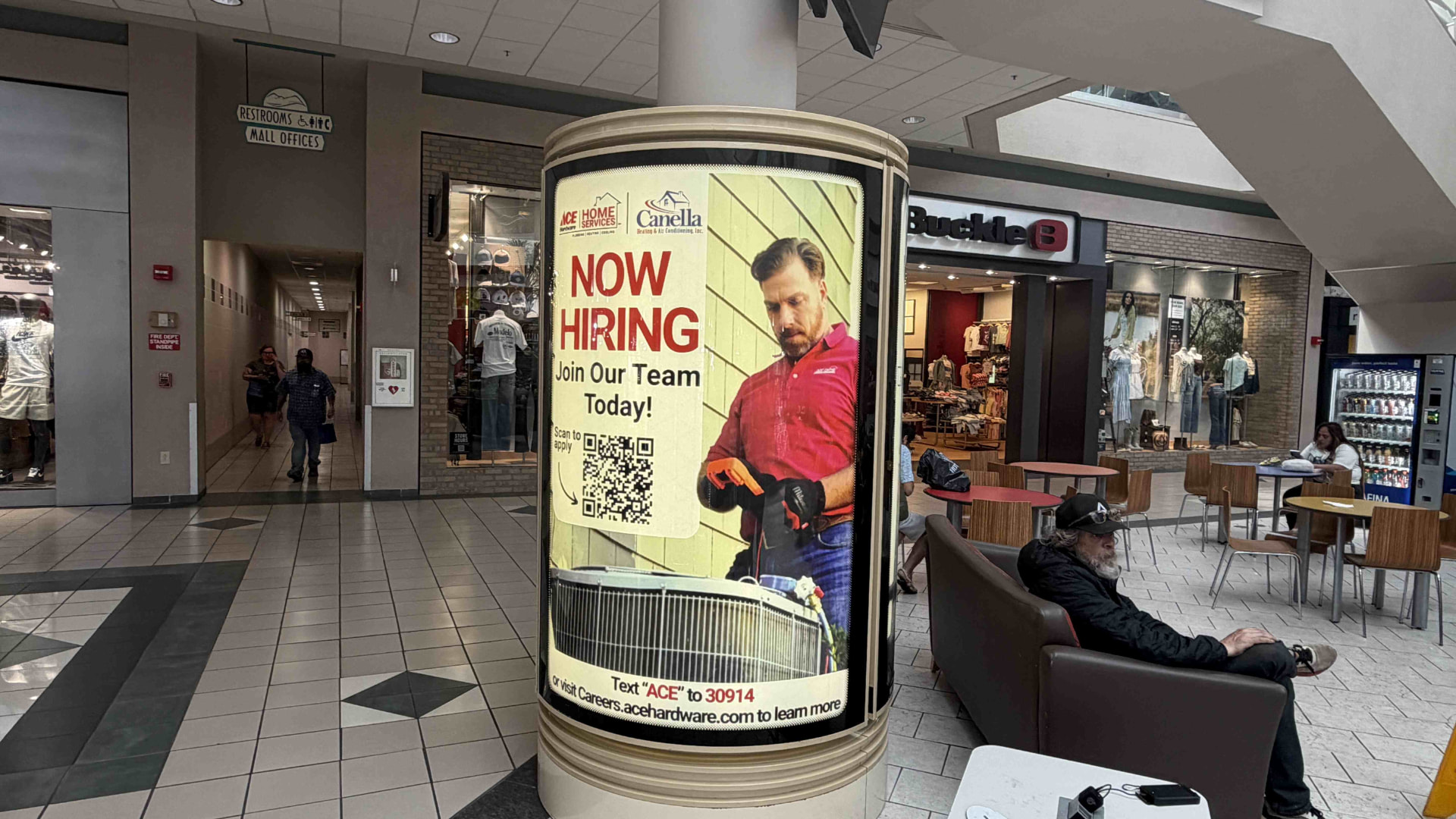
Job boards reach people actively looking. In a tight labour market that is a small fraction of the people who might take a job if the right one appeared in front of them, and it is the fraction every competing employer is also paying to reach.
Shopping center advertising reaches the rest: employed people, returning workers, students, and anyone who has not thought about changing jobs this week.
Reaching passive candidates
Most of the workforce is not on a job board on any given day, but nearly all of it goes shopping. A hiring message in a mall reaches people who are not looking, which is exactly the audience a job board cannot sell you.
It also reaches them in a relaxed frame of mind rather than in a competitive listing environment, which makes a distinctive employer message far easier to notice.
Formats for hiring campaigns
Hiring messages need enough space for a role, a wage indication, and a way to apply, which favours dwell-heavy placements with a scannable code.
- Food court panels where seated readers can absorb detail
- Directory advertising near mall employer entrances
- Digital screens for changing role lists and urgency messaging
- Column wraps and floor graphics near entrances
- Standees with take-away application information
What to put on a hiring advertisement
Specificity drives response. "Now hiring" alone is close to invisible; a named role with a wage range and a location produces applications.
State the pay if you can. Wage transparency is increasingly expected and in several jurisdictions required, and campaigns that include it consistently outperform those that do not.
Geography and commute
People take jobs near where they live. Advertising in the shopping center closest to the worksite reaches exactly the commute-viable candidate pool, which is a far better filter than most job board targeting offers.
For multi-site employers, buying the center nearest each location gives a distributed recruitment campaign with no wasted geography.
Seasonal hiring
Retail and logistics hire heavily from September for the holiday peak, hospitality hires in spring, and many employers see a January application surge. Campaign timing should lead those windows by several weeks so the pipeline is full when it is needed.
Measuring recruitment campaigns
Use a dedicated application landing page per placement, track applications by source and ZIP code, and measure cost per hire rather than cost per click. Against competitive job board pricing, well-placed mall media frequently compares favourably.
Frequently asked questions
Is mall advertising effective for hourly roles?
Very. The mall audience overlaps closely with the local hourly workforce and includes people not actively searching.
Should the ad include pay rates?
Yes where possible. It materially increases response and meets transparency expectations.
How do candidates apply?
A QR code to a mobile-friendly application page works well in high-dwell placements, ideally a short form.
How long should a hiring campaign run?
At least a full four-week flight, and longer for continuous hiring needs where a steady pipeline matters.
Sources
- SHRM talent and recruiting research
- Bureau of Labor Statistics consumer expenditure data
- ICSC shopping center industry research
- Out of Home Advertising Association of America
- U.S. Small Business Administration marketing guidance
Related reading
Ready to apply these industries insights? MallAds.com brings more than 20 years of shopping-center and billboard experience to campaigns built around your market, audience, and budget.