

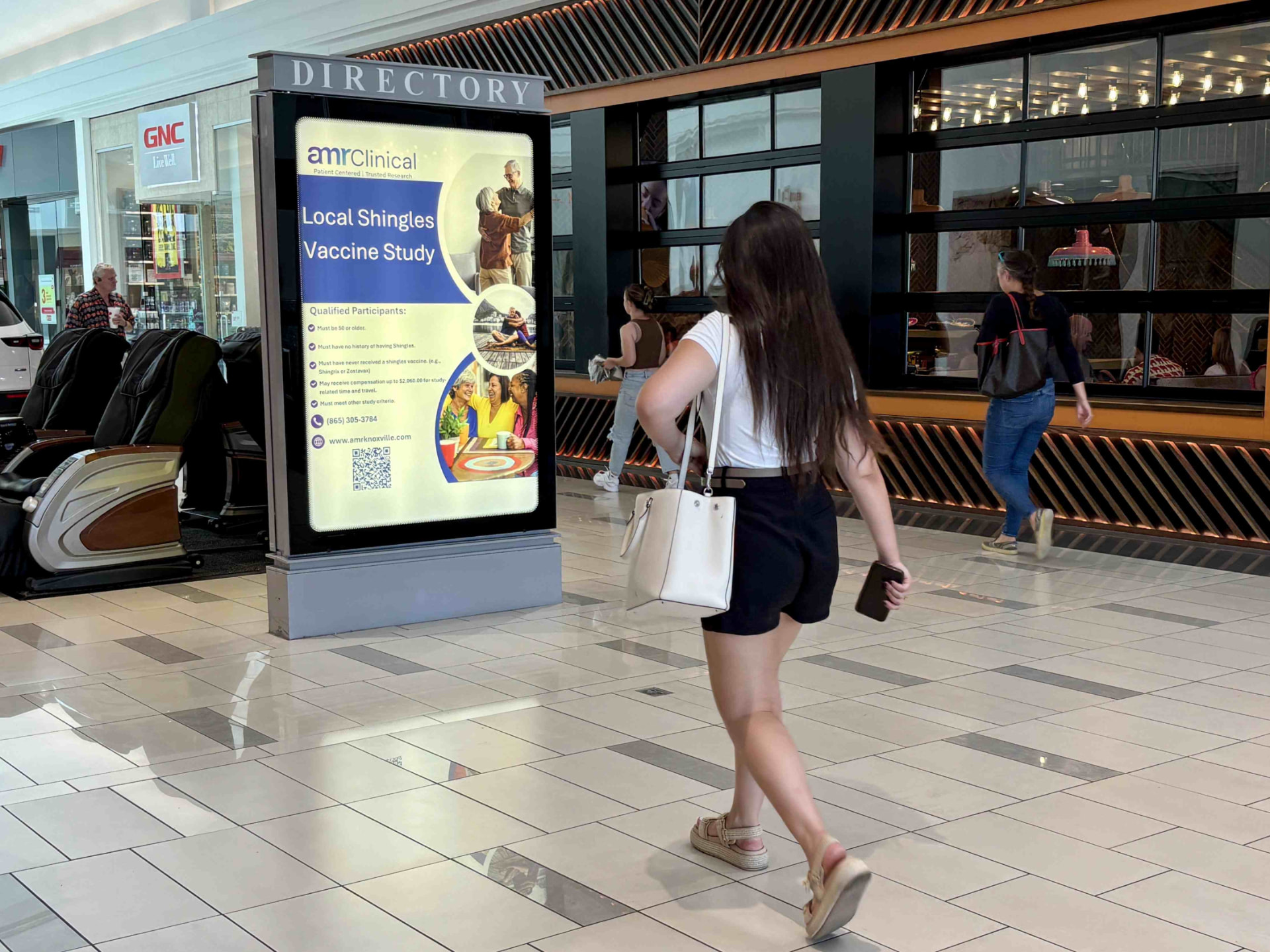
QR codes came back for a reason: every modern phone camera reads them natively, with no app required. In out-of-home that changed the format from a novelty into a genuine response mechanism, but only in the placements where the conditions are right.
This article covers where codes work, where they are wasted, and how to design a scan path that does not lose people at the landing page.
The conditions a QR code needs
Three things must be true: the viewer must be stationary, the code must be within reasonable distance, and the phone must be reachable. Miss any one and scan rates collapse.
That is why food court panels, directories, escalator wraps, and seating-area placements produce scans while highway billboards and high sky banners almost never do.
Where codes perform in a mall
Ranked roughly by scan performance, the strongest positions share long dwell and short viewing distance.
- Food court seating panels and table media
- Mall directories where shoppers have already stopped
- Escalator wraps at eye level during the ride
- Kiosks and standees at close approach distance
- Restroom corridor and lounge panels
Design rules
Make the code larger than feels necessary, place it at eye height, and give it a quiet zone with high contrast. Never print a code over a photograph or a gradient.
Tell people why to scan. A bare code gets ignored; a code with three words of reason next to it, such as "see this week's rates" or "book an appointment", performs several times better.
The landing page matters more than the code
Most QR campaigns fail after the scan, not before it. The destination must load in under two seconds, be built for a phone held in one hand, and deliver exactly what the ad promised without an interstitial or a homepage detour.
Build a dedicated page per placement. It costs almost nothing and gives you clean measurement of which position and which creative produced the response.
Realistic expectations
Scan rates in out-of-home are low in absolute terms because the medium's job is mostly to plant a message that is acted on later. A code should be treated as a bonus signal and a creative diagnostic, not as the campaign's primary success measure.
Judge scans relatively: this placement versus that one, this creative versus the alternative.
Alternatives worth considering
A short, memorable vanity URL still outperforms a QR code in fast-moving environments, and a dedicated phone number works well for services where people prefer to call. Use the mechanism that fits the audience and the setting rather than defaulting to a code everywhere.
Frequently asked questions
Do QR codes work on billboards?
Rarely. Drivers cannot safely scan, and the distance defeats the camera. Use a vanity URL instead.
How big should a QR code be?
Larger than you think, with clear space around it. Scale it to the expected viewing distance and test with a real phone.
Should the code go on every placement?
Only where dwell and distance support it. Elsewhere it takes up space that a stronger visual would use better.
Can I track scans by placement?
Yes, by giving each placement its own destination URL, which is the single most useful measurement step you can take.
Sources
- Think with Google consumer insights
- Out of Home Advertising Association of America
- IAB digital advertising standards
- Pew Research Center
- Nielsen advertising research
Related reading
Ready to apply these measurement insights? MallAds.com brings more than 20 years of shopping-center and billboard experience to campaigns built around your market, audience, and budget.