

Everywhere else in a shopping center, your audience is moving. In the food court they are seated, often for twenty minutes or more, frequently with nothing to look at but their phone and the room around them.
That makes food court media the right home for any message that needs more than six words: recruitment, healthcare services, financial products, enrollment, and anything requiring a considered decision.
Why dwell time changes the rules
Attention research across out-of-home consistently shows that recall rises with exposure duration. A concourse banner gets a fraction of a second; a food court panel facing a seated diner can get repeated glances across an entire meal.
That extra time is permission to explain. A hospital can list service lines. A university can name programs and a deadline. A staffing agency can list open roles and a start date.
Formats available in food courts
Most centers offer several ways to reach the seated audience, and the best plans combine two of them so the message appears in both the sightline and the immediate table environment.
- Wall-mounted backlits and panels facing the seating area
- Digital screens positioned above the seating zone
- Table tents and tabletop decals where permitted
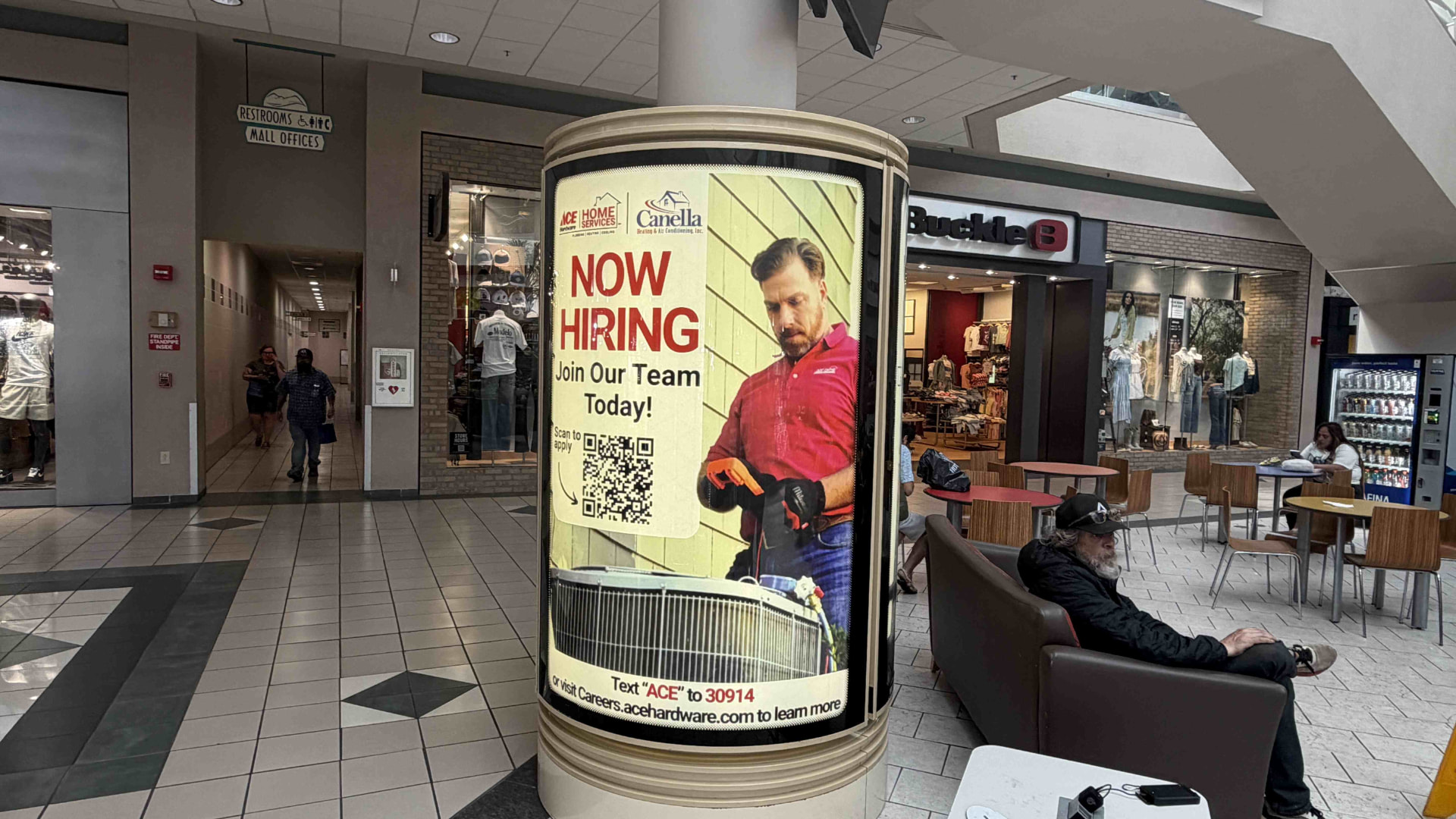
- Column wraps around the seating perimeter
- Floor graphics along the tray return and entry path
Who the food court audience is
Food court traffic skews toward families with children, teenagers and students after school, mall employees on break, and older shoppers taking a rest between stores. Weekday lunch and weekend afternoons are the two heaviest windows.
That mix makes food courts especially strong for employers, healthcare, education, and consumer financial services, all of which are selling to households rather than to a narrow retail segment.
Creative approach
Write for a reader, not a passerby. A headline plus three short supporting lines plus one action performs well. Include a QR code, because seated shoppers with phones in hand are the single most likely audience in the property to scan one.
Design for viewing across a room. Even seated, most diners are ten to thirty feet from a wall panel, so type still needs to be substantially larger than print standards.
Timing and seasonality
Food court traffic peaks with the school calendar and the holidays. Recruitment campaigns do well in late summer and January; healthcare enrollment messaging aligns with open enrollment periods; education marketing works hardest in the months before application deadlines.
Measuring response
Because the audience is stationary and phone-ready, food court placements produce the cleanest measurement signal in the mall. Use a distinct QR destination per placement and compare scan rates to judge both position and creative.
Frequently asked questions
Are table tents allowed in every mall?
No, policies vary and some centers reserve tabletops for tenant use. Availability is checked property by property.
Is food court inventory more expensive?
Rates are competitive with concourse media, and the dwell time usually makes the effective value higher.
Can I run longer copy here?
Yes. This is the one in-mall environment where a short paragraph is readable, though brevity still wins.
What times are busiest?
Weekday lunch, after-school hours, and weekend afternoons carry the heaviest seated traffic in most centers.
Sources
- ICSC shopping center industry research
- National Restaurant Association research
- Nielsen advertising research
- Out of Home Advertising Association of America
- National Retail Federation research
Related reading
Use this food court advertising guidance as a starting point, then ask MallAds.com to confirm current locations, formats, timing, and pricing for your campaign.