

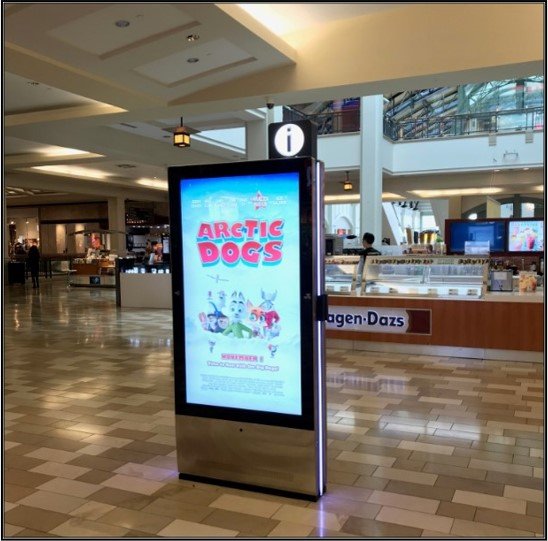
Choosing between a printed unit and a digital screen is not purely a creative decision. It changes the production cost structure, the flexibility to update a message mid-flight, and the type of content that performs well. Many advertisers default to whichever format they used last time without weighing the trade-offs against the current campaign's goals.
This article compares print and digital production across cost, flexibility, and creative capability, to help match the format to the campaign rather than the other way around.
Upfront production cost
Print production has a real, one-time cost: design, proofing, large-format printing, and installation labor. That cost is fixed regardless of how long the flight runs, which is why print units typically require a longer minimum commitment to make economic sense.
Digital placements avoid physical production entirely, since content is uploaded rather than manufactured, but the media rate for screen time often carries a premium that reflects the hardware and network infrastructure the media owner maintains.
Flexibility during the flight
This is where digital has a clear advantage. A digital screen's content can be swapped in hours, which matters for time-sensitive offers, inventory-driven messaging, or dayparting a message differently for morning versus evening traffic.
Print is locked for the duration of the flight once installed. Changing a printed message mid-flight means a full reprint and reinstallation, which is rarely cost-effective unless the campaign has a serious error to correct.
- Digital supports dayparting and rapid message swaps
- Print is fixed for the entire flight once installed
- Digital suits promotions with changing offers or dates
- Print suits a stable brand message meant to run unchanged
Creative capability differences
Digital formats support motion, sequencing multiple messages in a loop, and richer color range on a backlit screen. This makes digital better suited to storytelling across several frames or showing multiple products within one placement's rotation.
Print, particularly large-format applications like wall wraps or column wraps, offers a scale and physical presence that a screen cannot match. A full column wrap or an escalator wrap creates an immersive, hard-to-ignore environment that digital screens, generally smaller, cannot replicate.
Durability and weather considerations
Interior print units are generally durable for a multi-month flight without maintenance, but exterior applications face weather exposure that can fade colors or damage material over time, requiring UV-resistant inks and weatherproof substrates.
Digital screens need reliable power and network connectivity, and any hardware malfunction takes the placement offline until serviced, which is a real operational consideration for exterior digital units in particular.
Which format suits which objective
Choose print for a stable brand or location message meant to build recognition over a long flight, especially in large-format applications where scale itself is part of the impact. Choose digital for promotions with a shelf life, multi-message rotations, or any campaign that needs to react to changing conditions during the flight.
- Print: long-flight brand recognition, large-format impact
- Digital: time-sensitive offers, multi-message campaigns
Combining both in one campaign
Many effective campaigns use both: a long-flight print placement for consistent brand presence, paired with a digital unit in the same property carrying rotating, time-sensitive offers. This gets the recognition benefit of print and the flexibility of digital without forcing a single format to do both jobs.
Budgeting across the two formats
When comparing quotes across formats, look at total cost over the flight length rather than the upfront number alone. A digital placement with a higher weekly rate but no production cost can end up comparable to a print placement once the fixed printing expense is factored in, particularly for shorter flights.
Frequently asked questions
Is digital always more expensive than print?
Not necessarily once production cost is included. Digital avoids printing expense but often carries a higher media rate, so total cost depends on flight length.
Can I update digital content myself during a flight?
This depends on the media owner's system, but many allow scheduled content swaps with advance notice rather than instant self-service control.
Which format works better for a grand opening?
Digital is often better suited, since messaging can shift from countdown to opening-day content without a reprint.
Does print last as long as digital for a multi-month flight?
Yes for interior applications. Exterior print needs weather-resistant materials to hold up over several months.
Sources
- DPAA digital out of home industry resources
- Out of Home Advertising Association of America
- Geopath OOH audience measurement
- IAB digital advertising standards
- Statista out of home advertising statistics
Related reading
Use this print vs digital ooh production guidance as a starting point, then ask MallAds.com to confirm current locations, formats, timing, and pricing for your campaign.