

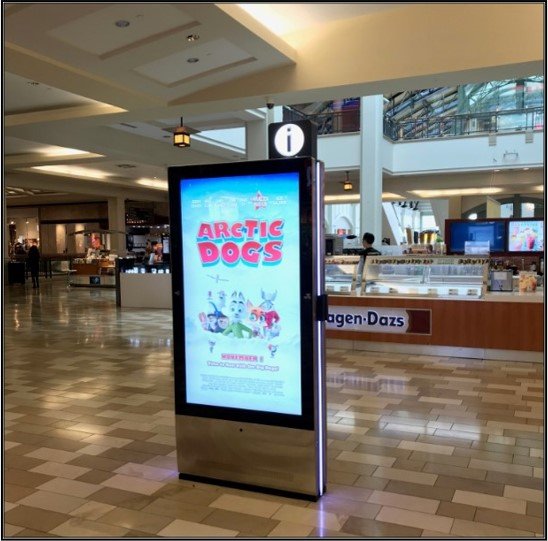
Kiosks are the format advertisers ask about most, because they sit at eye level in the middle of the walkway where shoppers slow down and look around. They are also the format most often misunderstood on price, since a digital kiosk is sold as a share of a rotating loop rather than as a permanent piece of wall.
This article explains how kiosk media is priced, what changes the rate, and how to judge whether a kiosk buy is better value than a static panel in the same center.
How kiosk advertising is actually sold
A digital kiosk runs a loop of advertisers. You buy a slot in that loop, typically expressed as a number of spots per hour or a share of voice. If the loop holds eight advertisers and runs continuously through mall hours, your creative appears roughly every eighty seconds all day, every day of the flight.
That structure is why kiosk pricing is quoted differently from static media. You are not renting a surface. You are renting recurring appearances in front of everyone who passes that point during the flight, which is a fundamentally different unit of value.
What moves the price up or down
Position inside the center is the biggest single factor. A kiosk at a center-court intersection or directly outside an anchor entrance sees several times the passing traffic of one tucked into a quieter wing, and rates follow that difference.
- Center tier and annual visits in the trade area
- Placement within the property, with center court commanding a premium
- Loop share, meaning how many advertisers you are sharing rotation with
- Screen size and whether the unit is single or double sided
- Flight length and the number of kiosks bought as a package
Kiosk versus static: the honest comparison
A static backlit is always on and never shares its space, so a shopper who looks at that wall sees only you. A kiosk shares attention with other advertisers but sits closer to the shopper path and can carry motion, which draws the eye far more reliably in a busy environment.
In practice, the two formats do different jobs. Static panels are excellent for brand presence and for messages that never change, such as a clinic name and phone number. Kiosks are better for time-sensitive offers, multi-message campaigns, and anything that benefits from animation or a QR code.
Creative rules that protect your investment
Kiosk creative fails when it is treated like a web banner. Shoppers give a screen a second and a half of attention while walking. Everything on it needs to be readable in that window: a large logo, one line of message, and one action.
Animation should be slow and simple. Fast cuts read as noise from twenty feet away, while a single graceful transition reads as premium. Avoid small legal text entirely; if you need a disclaimer, route it through a QR code to a landing page.
Building a kiosk budget that performs
The most common efficient buy is two or three kiosks in one center rather than one kiosk in three centers. Shoppers move through the property in loops, so multiple screens along that loop compound frequency inside a single visit.
If you are testing mall media for the first time, a single-center kiosk package across two consecutive flights is a clean experiment. Use a dedicated phone number, promo code, or landing page so you can attribute response before deciding whether to scale.
Questions to ask before you sign
Ask for the number of advertisers in the loop, the hours the screens operate, the daily impression estimate and where it comes from, and whether creative changes mid-flight are included. Those four answers tell you far more about value than the headline rate does.
- How many advertisers share the loop?
- What hours do the screens run?
- What is the audited or estimated audience?
- Are mid-flight creative swaps included?
- What is the file spec and deadline?
Frequently asked questions
Is a mall kiosk the same as a retail kiosk cart?
No. A retail merchandising cart is leased space where you sell products. An advertising kiosk is a media placement, usually a digital screen, that you rent for a message rather than for selling.
How many impressions does a kiosk deliver?
It depends on the center and the position, but a well-placed kiosk in a regional center is typically quoted in the tens of thousands of weekly impressions. Ask for the measurement source behind any figure.
Can I run video with sound?
Most mall networks run silent by design, so plan creative that works without audio. Motion and captions carry the message.
How fast can a kiosk campaign go live?
Digital placements can often launch within days of file delivery, since nothing needs to be printed or installed.
Sources
- DPAA digital out of home industry resources
- Out of Home Advertising Association of America
- Geopath OOH audience measurement
- Nielsen advertising research
- ICSC shopping center industry research
Related reading
Ready to apply these costs & budgeting insights? MallAds.com brings more than 20 years of shopping-center and billboard experience to campaigns built around your market, audience, and budget.