

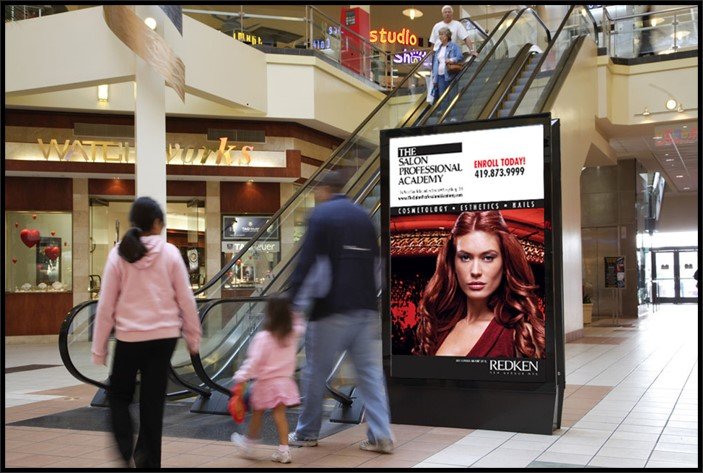
The honest answer to what mall advertising costs is that it depends on four things: which mall, which format, how many units, and how long you run. A single backlit panel in a community center for four weeks and a network of digital screens across a top-ten market are both mall advertising, and they are separated by two orders of magnitude in price.
Rather than publish a rate card that would be stale within a season, this article explains exactly what moves the number so you can walk into a proposal conversation with a realistic budget and get an accurate quote the first time.
The variables that actually set your rate
Mall media is priced per unit, per four-week flight. That flight length is the industry standard and it comes from the way inventory is scheduled and installed. Within that structure, five variables do nearly all of the work in determining the number on your proposal.
Market tier matters most. A Class A regional center in a dense metro with strong anchor tenants and high dwell time carries a higher rate than a community center serving a smaller trade area, because the audience delivered per flight is genuinely larger. Format is the second lever: a static banner is a printed piece hung once, while a digital panel is a share of a rotating loop with its own hardware and network costs behind it.
- Market and center tier, measured by trade-area population and annual visits
- Format, from static banners and backlits to digital panels and spectaculars
- Unit count, since buying multiple faces lowers your effective cost per unit
- Flight length, with longer commitments earning better rates
- Production and installation, a one-time cost on static media
What a small local budget buys
Local advertisers such as a dental practice, a credit union branch, or a franchise restaurant typically start with one or two placements in the single center closest to their location. The goal is not reach across a whole DMA. The goal is repetition in front of the people who already drive past your door every week.
At this level the biggest mistake is spreading a small budget thin. Two units in one mall for three consecutive flights will outperform six units scattered across six malls for one flight, because out-of-home works on frequency. A shopper who sees your message on four separate trips remembers your name. A shopper who sees it once does not.
What a regional or national budget buys
Regional brands generally buy a package: a set of formats repeated in every center across a defined footprint, so the creative reinforces itself as shoppers move through the property. National campaigns run dozens of centers across multiple markets, frequently pairing in-mall placements with billboards on the roads that feed those centers.
At the national level, planning shifts from picking units to picking coverage. We start from your store, clinic, dealership, or campus locations and layer mall inventory only where it overlaps with the audience you are trying to reach, which keeps waste out of the buy.
Production, installation, and the costs behind the media rate
Static formats carry a one-time production charge covering printing on the correct substrate and professional installation by an approved vendor. Malls have strict rules about hardware, fire ratings, and after-hours work, so this is not a place to cut corners with a local print shop.
Digital formats usually have no production cost beyond building the creative file, which is one reason advertisers testing a new message often start digital. You can change the artwork mid-flight without paying to reprint and rehang anything.
Getting more out of the budget you have
Concentrate rather than scatter, buy the shopper path rather than the single highest-traffic wall, and consider shoulder seasons when availability is stronger and rates soften. A January or late-summer flight often delivers more units per dollar than a November flight competing with holiday demand.
- Choose the centers closest to your physical footprint first
- Buy two or three touchpoints along one shopper path instead of one showpiece unit
- Commit to multiple consecutive flights to earn better pricing
- Test in one market before scaling to a multi-market package
- Ask what is currently unsold; last-minute inventory is negotiable
How to get an accurate quote quickly
The fastest path to a real number is to tell a media partner three things: the markets or ZIP codes you care about, roughly what you are prepared to spend per month, and what you want the campaign to accomplish. With those three inputs we can check live availability and return a specific plan rather than a generic price range.
If you are comparing options, ask every vendor to quote the same flight length and the same market so the numbers are actually comparable. Quotes that mix a four-week rate with a twelve-week rate look wildly different for no real reason.
Frequently asked questions
Is there a minimum spend for mall advertising?
Most centers sell in four-week flights with a one-unit minimum, so entry-level campaigns are accessible to single-location businesses. The practical minimum is whatever buys enough frequency to be remembered, which usually means more than one flight.
Why do rates change between malls in the same city?
Rates track audience. Two centers ten miles apart can differ substantially in annual visits, dwell time, and shopper demographics, and pricing reflects that difference.
Do I pay for production every time?
Only on static media, and only when the creative changes. Digital placements avoid production entirely because the artwork is a file, not a printed piece.
Can I advertise in a mall without a store in that mall?
Yes. Most mall advertisers are not tenants. Healthcare systems, banks, universities, telecoms, and service brands all buy mall media purely for the audience.
Sources
- Out of Home Advertising Association of America
- ICSC shopping center industry research
- Geopath OOH audience measurement
- Statista out of home advertising statistics
- U.S. Census Bureau retail trade data
Related reading
MallAds.com helps advertisers turn how much does it cost to advertise in a mall research into a practical media plan, with placement support across more than 1,700 malls and billboard markets nationwide.