

Radio has been the default local media buy for decades because it is simple to book and easy to understand. Mall advertising asks a harder question up front, but for many local and regional advertisers it answers the same goal, reaching people in a defined trade area, more efficiently and with a visual message that radio cannot deliver.
This comparison looks at how the two channels actually perform against each other rather than treating them as interchangeable local media, and where a combined plan beats either one alone.
How each channel reaches an audience
Radio reaches people while they are doing something else, mostly driving, working, or half-listening at home. That divided attention is radio's core limitation: the message has to survive being background noise, and there is no visual to anchor recall.
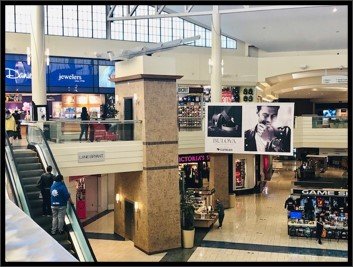
Mall advertising reaches people while they are physically present in a retail environment, already in a spending mindset, and moving past static or digital displays repeatedly during a single visit. A shopper who sees a backlit panel near the food court is not multitasking away from it the way a driver is from a radio spot.
Cost and buying structure
Radio is typically sold on a spot and rating basis, with cost driven by daypart and station reach. It scales down easily for small local budgets but rates can climb quickly for drive-time slots, and a schedule needs enough frequency to be remembered.
Mall advertising is typically sold by placement and flight length rather than by impression, which makes budgeting more predictable. A single well-placed static panel can run for months at a fixed cost, compared with a radio schedule that needs continuous spend to maintain frequency.
- Radio: cost scales with daypart, station rating, and spot frequency
- Mall: cost is largely fixed per placement and flight length
- Radio needs ongoing spend to sustain frequency and recall
- Mall placements accumulate exposure passively across a long flight
Attention and message retention
A radio spot has roughly fifteen to thirty seconds to land a message with no visual support, and the listener cannot glance back at it. Retention depends heavily on repetition across the schedule.
A mall placement is seen, often repeatedly, by the same shopper across one visit and across return trips, and it carries a logo, image, and call to action that a listener can absorb visually rather than aurally. For messages that depend on recognition, such as a business name or a storefront look, visual media outperforms audio.
Targeting a trade area
Radio station coverage areas are broad and often extend well beyond a business's realistic customer base, meaning a meaningful share of the buy reaches people who will never visit. Some stations offer geotargeted digital add-ons, but the core broadcast reach is not adjustable.
Mall advertising is naturally confined to the trade area the property draws from, which for most malls is a tight radius of surrounding neighborhoods and commuting routes. For a retailer or service business with a defined service area, that precision reduces wasted spend considerably.
When radio still makes sense
Radio has real strengths: it is fast to produce, easy to change, and effective for time-sensitive announcements such as a weekend sale or an event date. It also reaches people in transit, which mall advertising does not directly address.
- Time-sensitive promotions with a hard deadline
- Businesses along commuting routes without a mall presence nearby
- Categories that rely on voice and tone, such as personality-driven local brands
Running both together
The strongest local plans often use radio for urgency and mall advertising for sustained recognition. A radio spot can drive a shopper to look for a business, and repeated exposure to a mall placement in the same trade area reinforces that the name is familiar and trustworthy once they are ready to buy.
Coordinating creative across both, using the same tagline, colors, and offer, compounds the effect rather than treating the channels as separate campaigns.
Frequently asked questions
Is mall advertising more expensive than radio?
It depends on market and format. A single mall placement running for months is often comparable to or less than a sustained radio schedule needed to hit the same frequency.
Which is better for a grand opening?
Radio is often faster to launch for an announcement, but mall placements booked in advance build recognition before the doors even open.
Can I measure mall advertising the way I measure radio?
Yes, using dedicated phone numbers, QR codes, and store traffic comparisons, the same attribution logic used for radio call tracking applies.
Does mall advertising work for a business without a mall storefront?
Yes. Service businesses, healthcare providers, and local retailers without a mall location regularly advertise in malls to reach the surrounding trade area.
Sources
- Nielsen advertising research
- Out of Home Advertising Association of America
- Geopath OOH audience measurement
- Think with Google consumer insights
- Comscore audience measurement
Related reading
Use this mall advertising vs radio guidance as a starting point, then ask MallAds.com to confirm current locations, formats, timing, and pricing for your campaign.