

Every out-of-home plan is a decision about two numbers: how many different people see the campaign, and how often each of them sees it. Reach and frequency are the whole game, and most underperforming campaigns got the balance wrong rather than picking bad locations.
This article explains both, how they trade against each other on a fixed budget, and how to decide which one your campaign needs more of.
Definitions that matter in practice
Reach is the number of unique people exposed at least once during a period. Frequency is the average number of exposures each of those people receives. Multiply them and you get gross impressions, which is the number most proposals lead with and the least useful of the three.
Two campaigns can deliver identical impressions with completely different effects: one reaching many people once, the other reaching few people many times.
When to prioritise reach
Reach wins when the message is simple, the brand is already known, and the objective is to make as many people as possible aware of something specific such as an opening, a sale, or a date.
- New store or facility opening
- Time-limited event or promotion
- Established brand with a simple new offer
- Political or public information campaigns
- Broad consumer categories with universal relevance
When to prioritise frequency
Frequency wins when the brand is unfamiliar, the purchase is considered, or the message needs to be understood rather than merely noticed. Recognition of a new name typically requires several exposures before it registers as familiar.
For a local service business entering a market, three well-placed units in one trade area almost always beat twelve units spread thinly across the region.
How mall media delivers frequency naturally
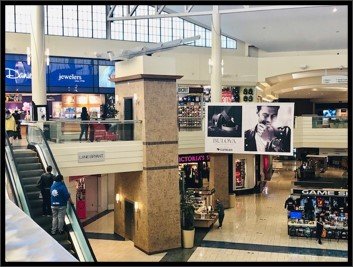
Shoppers move through a shopping center in predictable loops and return to the same property repeatedly across a month. A set of placements along that loop delivers multiple exposures per visit and multiplies across repeat visits, producing high frequency without buying more inventory.
This is the structural reason in-mall media tends to outperform its impression count for brands that need to be learned rather than merely reminded.
Setting a working target
A common practical planning approach is to aim for enough frequency that a typical member of the target audience sees the campaign several times over a four-week period, then extend reach with whatever budget remains.
Resist the temptation to buy one unit in every market. Concentration beats dispersion at almost every budget level below national scale.
The flight length dimension
Frequency accumulates over time as well as across units. A four-week flight on three units often produces a stronger result than a two-week flight on six, and it costs the same. Longer flights also reduce the per-week impact of production costs.
Frequently asked questions
How many exposures does someone need?
It varies by category and brand familiarity, but unfamiliar brands generally need several exposures before recognition forms.
Is a bigger impression number always better?
No. Impressions hide the reach and frequency split, which is what actually determines the campaign effect.
Should a small budget go wide or deep?
Deep, nearly always. Concentrate in one trade area until it is working, then expand.
Does mall media build frequency faster than roadside?
Within a single trade area it usually does, because shoppers pass multiple placements per visit and return regularly.
Sources
- Geopath OOH audience measurement
- Out of Home Advertising Association of America
- Nielsen advertising research
- Association of National Advertisers
- Harvard Business Review on advertising effectiveness
Related reading
MallAds.com helps advertisers turn reach and frequency ooh research into a practical media plan, with placement support across more than 1,700 malls and billboard markets nationwide.