

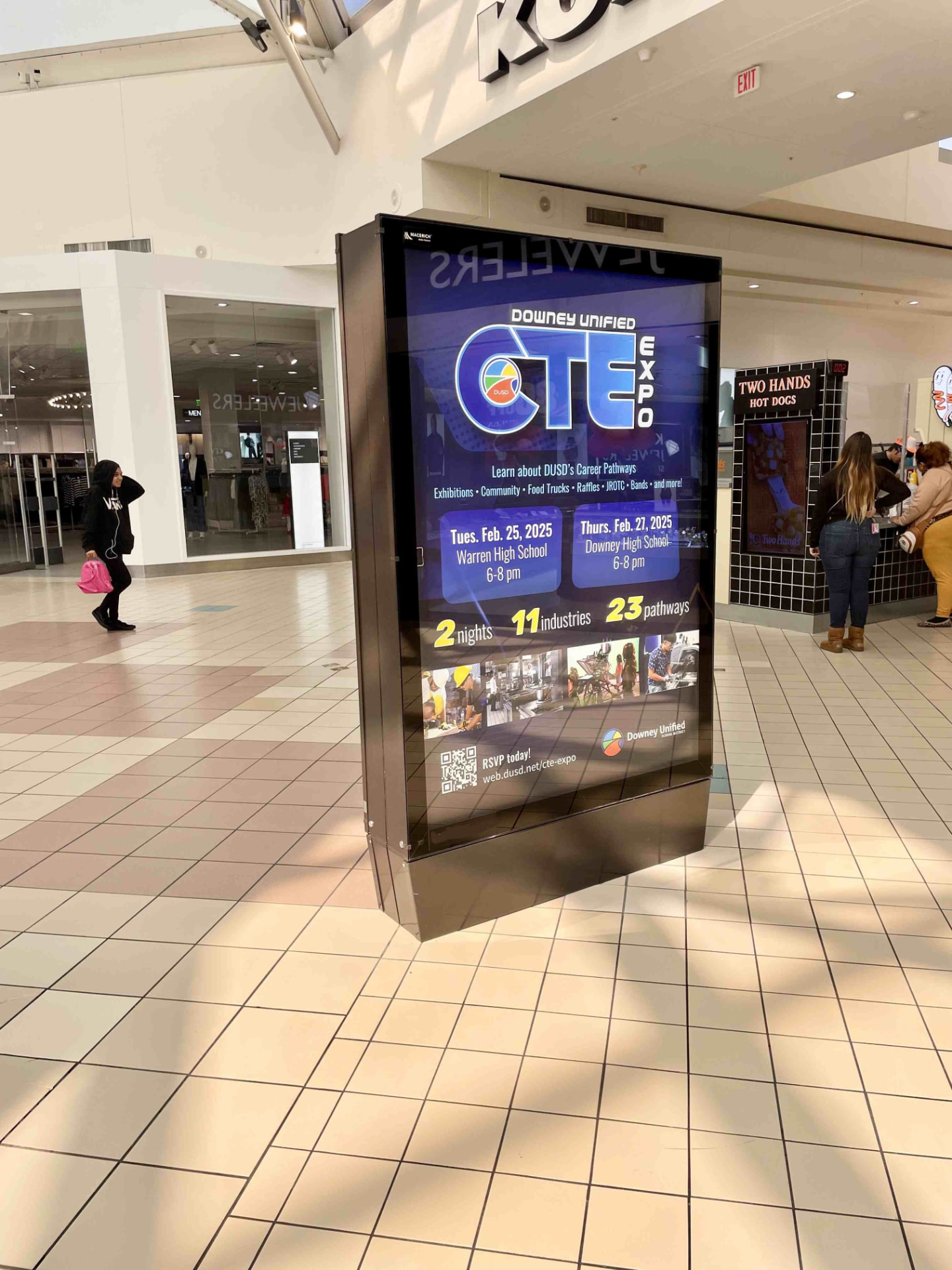
Enrollment marketing has become a bidding war on search terms, and the cost per inquiry in competitive education categories has climbed steeply. Out-of-home offers a different route: reaching prospective students and, just as importantly, the parents and partners who influence the decision.
This article covers how institutions use shopping center advertising for enrollment, and how to align it with the application calendar.
Reaching influencers, not just applicants
Education decisions are rarely made alone. Parents, spouses, and employers all shape them, and none of those people are typing the search terms an institution bids on.
Mall audiences include all of them in the same place. A placement seen by a parent and a prospective student on the same trip does something a targeted digital advertisement cannot.
Formats that fit enrollment messaging
Program names, deadlines, and outcomes need reading time, so dwell-heavy placements carry the detail while high-visibility units carry the institution name.
- Food court panels listing programs with an application deadline
- Directory advertising for campus location and open house dates
- Digital screens counting down to enrollment deadlines
- Standees with take-away program brochures
- Column wraps for repeated exposure during the decision window
Trade schools and workforce programs
Career and technical education has a particularly good fit with mall audiences, because the target student is often a working adult or recent graduate who is not currently in an academic environment where the institution can reach them.
Concrete messaging works best: the trade, the program length, the credential, and a start date. Vague aspirational copy underperforms specifics in this category.
The enrollment calendar
Traditional institutions run application cycles in the autumn for the following year, with a second wave in spring. Trade and continuing education programs have rolling or term-based starts and can advertise year-round against the next available cohort.
In both cases the campaign should be live several weeks before the deadline being promoted, not in the final days.
Outcome messaging and compliance
Any claim about employment rates, salaries, or completion must be substantiated and presented accurately. Education advertising receives regulatory attention, and out-of-home is not exempt because the space is small.
Keep claims general on the placement and put the substantiating detail on the landing page the QR code leads to.
Measuring enrollment campaigns
Track inquiries and applications by ZIP code, use a campaign-specific landing page and phone number, and ask on the inquiry form where the prospect heard of the institution. Compare inquiry volume in the campaign market against prior cycles.
Frequently asked questions
Do students notice mall advertising?
Yes, and so do the parents and partners who influence the decision, which is the larger part of the value.
How far ahead of a deadline should a campaign run?
Several weeks at minimum. Enrollment decisions take time and last-minute campaigns miss the consideration window.
Is out-of-home cheaper than search for education?
On a per-thousand basis, considerably. It also reaches people who are not yet searching.
What message performs best?
Specific programs, credentials, and start dates outperform general institutional messaging.
Sources
- National Center for Education Statistics
- Bureau of Labor Statistics consumer expenditure data
- FTC advertising and marketing rules
- ICSC shopping center industry research
- Out of Home Advertising Association of America
Related reading
Use this higher education advertising guidance as a starting point, then ask MallAds.com to confirm current locations, formats, timing, and pricing for your campaign.