

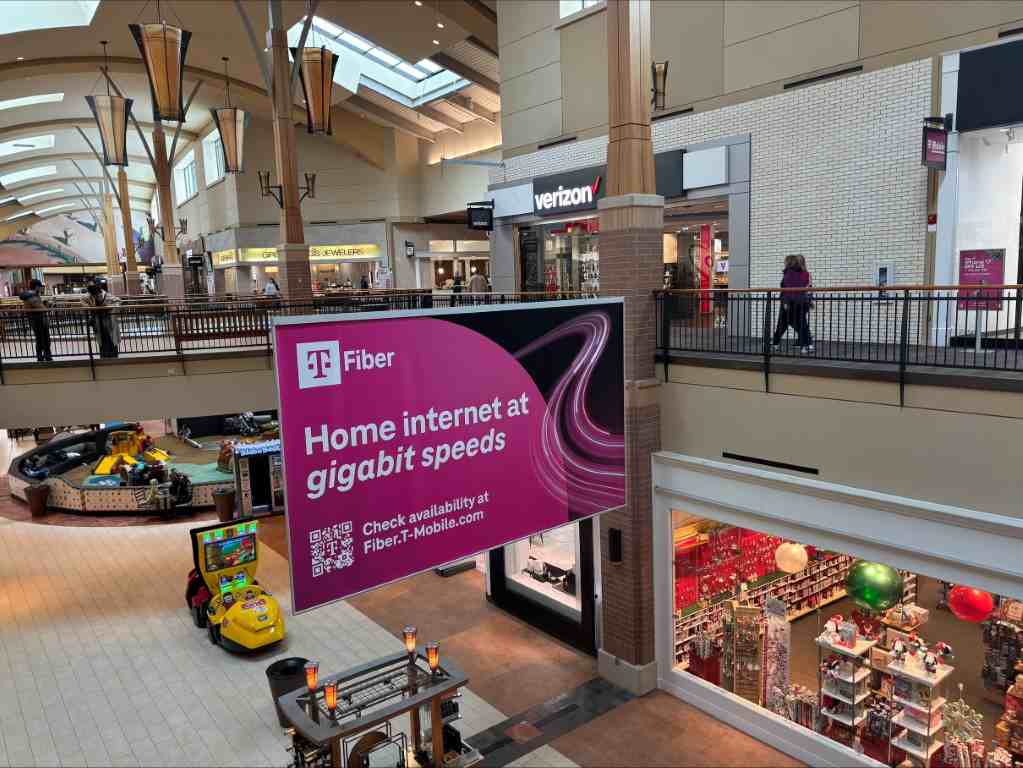
Geofencing delivers mobile advertisements to people inside a defined geographic boundary. Pair it with physical placements inside the same shopping center and you get something neither channel produces alone: the same message on a large screen in front of the shopper and on the phone in their hand.
This article explains how the pairing works in practice and where the technique is oversold.
How geofencing works
An advertiser draws a boundary around a location and serves mobile advertisements to devices detected inside it, sometimes for a period after they leave. Targeting is based on device location signals from apps and ad exchanges.
Accuracy varies. Indoor precision is weaker than most vendors imply, and dense properties such as malls can produce spill into neighbouring areas.
Why pairing it with in-mall media works
The physical placement provides scale, credibility, and unavoidable presence. The mobile advertisement provides a clickable, immediate response path. Seeing both in the same visit produces recognition on the phone rather than an unfamiliar banner.
- Same creative and colours across both channels
- Physical placements in the highest dwell zones
- Mobile retargeting for a period after the visit
- One landing page shared by both, built for mobile
- Consistent offer and deadline in each channel
Realistic expectations
Geofencing is inexpensive per impression and easy to run, but mobile display click-through rates are low and the inventory quality is uneven. Treat it as a support layer, not as the campaign.
The value is in the combination. Judged in isolation, a geofencing campaign usually looks unimpressive; judged as the response layer under a strong physical presence, it earns its place.
Competitive conquesting
Some advertisers fence a competitor's location. It is legal and common, but it is a blunt tool: you reach everyone in the area, most of whom are not competitor customers, and the message must be strong enough to change a decision already in progress.
Fencing your own trade area and the shopping centers where your customers already go is usually a better use of the budget.
Privacy considerations
Location-based advertising sits inside a shifting regulatory environment, and platform-level privacy changes have reduced the volume and precision of available signals. Work with partners who are explicit about data sources and consent, and avoid targeting sensitive locations.
Structuring the combined buy
Put the majority of the budget into the physical placements, which are the reason anyone notices the campaign, and allocate a smaller share to mobile as the response and measurement layer. Use the mobile side's reporting to gauge relative interest between markets.
Frequently asked questions
How accurate is geofencing indoors?
Less accurate than vendors often suggest. Assume approximate coverage rather than precise room-level targeting.
Is competitor conquesting effective?
It can work for high-consideration purchases but usually delivers a lot of wasted impressions.
Does geofencing replace in-mall advertising?
No. It has none of the scale, presence, or credibility of a physical placement, and mobile display is easily ignored.
What budget share should mobile take?
A minority. The physical placements should carry the campaign, with mobile supporting response.
Sources
- IAB digital advertising standards
- Pew Research Center
- Think with Google consumer insights
- Out of Home Advertising Association of America
- FTC advertising and marketing rules
Related reading
Use this geofencing mall advertising guidance as a starting point, then ask MallAds.com to confirm current locations, formats, timing, and pricing for your campaign.