

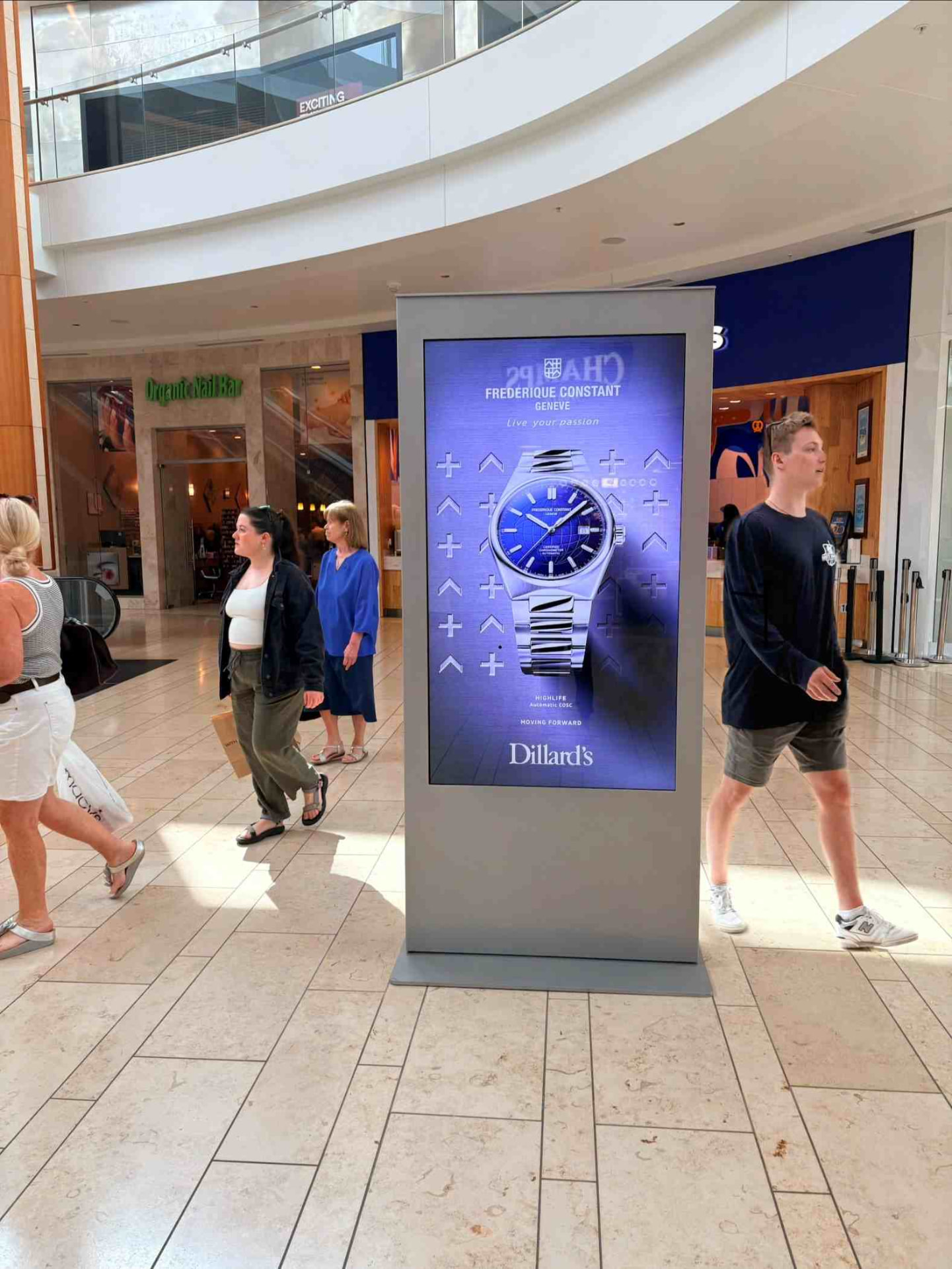
Many small business owners assume mall advertising belongs to national retail chains with large marketing budgets. In practice, a meaningful share of mall advertisers are local businesses, because several formats are priced for exactly that scale.
This article covers which formats fit a small business budget, how to write for a local audience, and what to expect from a first campaign.
Why mall advertising suits small businesses
A small business generally serves a limited local area, and a mall's audience is drawn from that same area. Unlike a citywide media buy, you are not paying to reach people who could never become customers, which makes the spend efficient even at a modest scale.
Shoppers also arrive at a mall in a relaxed frame of mind rather than mid-task, which suits a local business message that needs a moment of attention rather than a hard sell.
Formats that fit a small budget
Not every format in a mall requires a large-brand budget. Several are specifically priced for single-location, independent advertisers.
- Kiosk advertising for a compact, high-visibility presence
- Static banners in high-traffic corridors
- Directory listings for shoppers already looking for a business type
- Standee displays near entrances or food courts
Writing a message that works for a local shopper
Lead with what you offer and where to find you, since a mall audience is local and can act on that information immediately. A specific line, such as a service, product category, or nearby location, outperforms a generic slogan.
Include one clear next step, whether that is a store location within the mall, a phone number, or a short offer that gives someone a reason to visit this week rather than sometime.
Budgeting for a first campaign
Start with one strong placement rather than spreading a small budget across several formats. A single well-located kiosk or banner, run for a few months, will do more for recognition than the same money divided into short bursts across multiple spots.
- Choose one format and one strong location within the property
- Commit to a flight of at least a few months
- Reassess and expand once you can measure a response
Timing around local shopping patterns
Small business advertising benefits from timing around the periods when local shopping activity naturally rises, such as back-to-school, the holiday season, and any local events the mall hosts. Aligning a flight with these periods increases the audience without increasing the budget.
Tracking whether it is working
Use a simple, low-cost tracking method: ask new customers how they heard about you, use a distinct offer or code on the mall placement, or watch for a change in foot traffic during the flight compared with before it started.
Frequently asked questions
Is mall advertising realistic for a single-location business?
Yes. Formats such as kiosks, banners, and directory listings are priced with independent, single-location businesses in mind.
What is the cheapest way to start?
A directory listing or a single static banner in one high-traffic area is usually the lowest-cost entry point.
How do I know if it is working?
Ask new customers how they found you, use a unique offer code on the placement, and track foot traffic during the flight.
Should I advertise year-round or seasonally?
Either can work, but timing a flight around naturally busy shopping periods gets more exposure for the same budget.
Sources
- U.S. Small Business Administration marketing guidance
- ICSC shopping center industry research
- National Retail Federation research
- Out of Home Advertising Association of America
- U.S. Census Bureau retail trade data
Related reading
Use this mall advertising for small business guidance as a starting point, then ask MallAds.com to confirm current locations, formats, timing, and pricing for your campaign.