

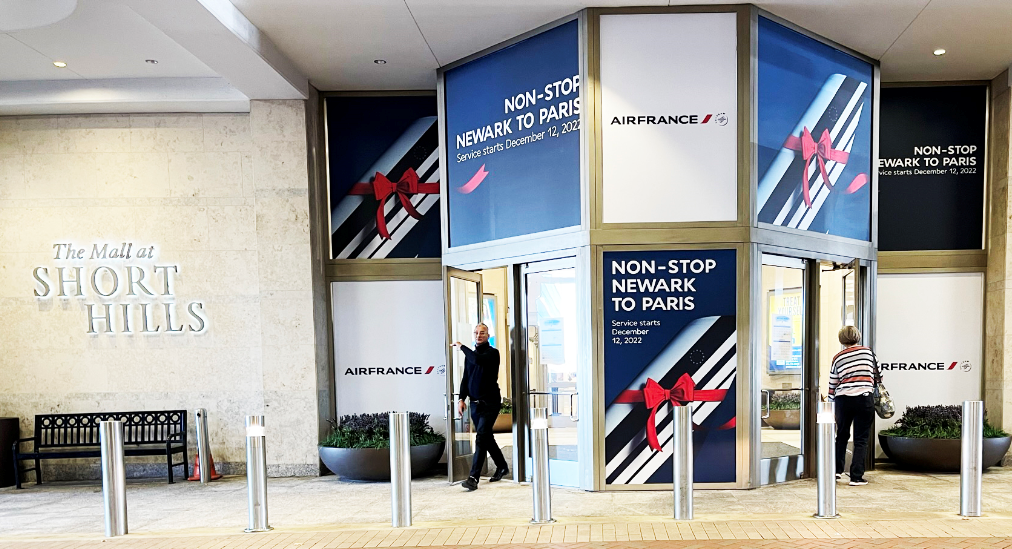
Shopping center advertising covers a wider range of formats than most people expect, from a small directory listing to a full exterior spectacular visible from the highway. Understanding the full picture makes it easier to pick the right entry point for your business.
This guide covers what shopping center advertising actually includes, who it works for, how pricing tends to be structured, and how to plan a first campaign.
What counts as shopping center advertising
The category spans interior and exterior media across a property. Interior formats include kiosks, banners, column wraps, escalator wraps, floor graphics, and digital screens. Exterior formats include spectaculars, sky banners, and signage visible from surrounding roads.
Each format differs in cost, production complexity, and the kind of message it suits, which is why a single property can support advertisers ranging from a local dentist to a national retail brand at the same time.
Who shopping center advertising works well for
It suits any business whose customers are drawn from a defined local or regional area, which covers most retail, healthcare, financial services, education, and local service businesses.
- Local businesses building name recognition in their trade area
- Regional and national brands running consistent local presence
- Service providers whose customers come from nearby neighbourhoods
- Seasonal advertisers timing offers around shopping periods
How pricing is generally structured
Pricing depends on format, location within the property, and flight length, with high-traffic spots such as entrances and food courts commanding a premium over less visible locations. Rates are not usually published, so most advertisers get quotes directly.
Longer flights typically bring the effective monthly cost down, and static formats generally cost less than digital screens once production is factored in, though digital offers more flexibility to change the message during the flight.
How the audience compares with other channels
Shopping center traffic represents a genuine cross-section of the local community rather than a narrow demographic, and it reaches people while they are out and receptive, not scrolling past an advertisement between other tasks.
That broad, local, present-moment audience is what makes shopping center advertising complementary to digital targeting rather than a replacement for it.
Planning your first campaign
Start with a clear goal and a realistic trade area, then match format to both. A new business needs recognition first, so a well-placed static banner or kiosk over several months often outperforms a short digital burst.
- Define the audience and the trade area before choosing a property
- Pick one strong format rather than several small ones
- Commit to a flight long enough to build recognition
Measuring results
Use a dedicated phone number, a unique offer code, or a QR code to track direct response, and watch for shifts in foot traffic or local search interest for your business name during the flight.
Frequently asked questions
What formats fall under shopping center advertising?
Kiosks, banners, digital screens, column and escalator wraps, floor graphics, directory listings, and exterior signage all fall under this category.
Is shopping center advertising only for large brands?
No. Many formats, such as kiosks and static banners, are priced for independent and local businesses.
How long should a first campaign run?
Several months is a reasonable starting point, since recognition builds gradually rather than after a single short flight.
How is shopping center advertising priced?
By format, location within the property, and flight length. Longer flights generally reduce the effective monthly cost.
Sources
- ICSC shopping center industry research
- National Retail Federation research
- Out of Home Advertising Association of America
- Geopath OOH audience measurement
- DPAA digital out of home industry resources
Related reading
Ready to apply these getting started insights? MallAds.com brings more than 20 years of shopping-center and billboard experience to campaigns built around your market, audience, and budget.