

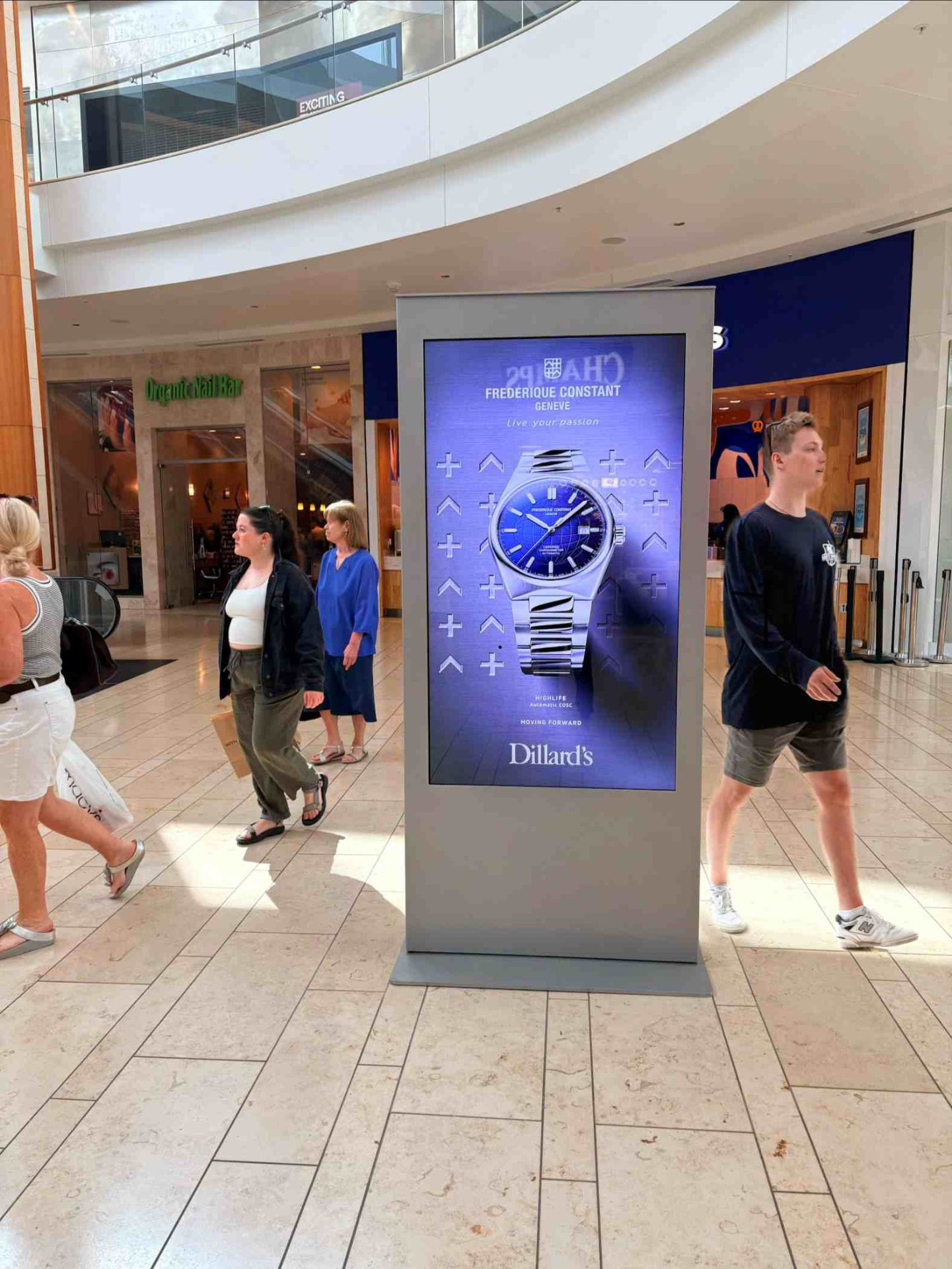
There is one place where every person present has already decided to spend money today. Advertising to a shopper inside a mall is not an interruption of their day; it is a contribution to the task they are actively performing.
This article covers how retail brands use in-mall media, both to support their own stores and to reach shoppers in centers where they have no presence at all.
Advertising with a store in the center
Tenants have the shortest possible path from advertisement to purchase. Placements should be positioned along the routes leading to the store, carry a directional cue, and give a reason to detour now.
Directory advertising is particularly valuable for tenants, because shoppers reading a directory are literally deciding where to go next.
Advertising without a store in the center
Non-tenant brands use mall media to reach shoppers in buying mode and route them elsewhere: to a nearby standalone location, to an online store, or to a retail partner in the center.
- Driving traffic to a nearby off-mall location
- Supporting a product sold inside an anchor department store
- Building awareness ahead of a store opening in the market
- Promoting an online offer to a physically present audience
- Reaching a competitor's customers in the same property
Vendor and brand-partner campaigns
Manufacturers whose products sit inside a department store often advertise in the mall to drive shoppers to that department. A standee or display near the entrance, paired with in-store presence, links awareness directly to the shelf.
These campaigns frequently qualify for co-operative funding, which changes the budget conversation substantially.
Seasonal retail intensity
Retail out-of-home in shopping centers is driven by the calendar: back-to-school, the holiday quarter, and the post-holiday clearance period carry the most weight, followed by spring and Mother's Day.
Because premium inventory sells out for those windows, retail advertisers need the longest booking lead times of any category.
Creative for shoppers already in motion
Keep it to product, price or offer, and location. Shoppers in a mall are executing, not researching, so a specific item at a specific place performs better than brand storytelling.
Use imagery of the actual product. Abstract brand creative underperforms in an environment where everything else on display is a concrete thing you can buy.
Measurement
Compare store traffic and sales at the location during flights against control locations, use an offer code unique to the placement, and track online orders originating in the campaign trade area.
Frequently asked questions
Do I need a store in the mall to advertise there?
No. Many advertisers have no presence in the property and buy purely for the shopper audience.
What is the best format for driving store visits?
Kiosks and directories along the route to the store, because they reach shoppers mid-decision.
How early should holiday retail be booked?
Three to five months ahead. Premium inventory in strong centers sells out well before the season.
Can co-op funds pay for mall advertising?
Frequently yes. Check the vendor's co-op guidelines, as out-of-home is commonly eligible.
Sources
- National Retail Federation research
- ICSC shopping center industry research
- U.S. Census Bureau retail trade data
- Out of Home Advertising Association of America
- Statista out of home advertising statistics
Related reading
MallAds.com helps advertisers turn retail brand mall advertising research into a practical media plan, with placement support across more than 1,700 malls and billboard markets nationwide.