

Floor graphics work because people watch where they are walking. In a crowded concourse the floor is one of the few surfaces guaranteed to be in a shopper's field of view, and a well-placed graphic can act as both an advertisement and a wayfinding cue toward a store, kiosk, or event.
This article covers placement strategy, material requirements, and how to use floor media as part of a larger campaign rather than as a novelty.
Where floor graphics belong
The best positions are decision points: the top of an escalator, the junction of two concourses, the threshold of an anchor store, and the walkway between the parking entrance and the main circulation loop.
Avoid positions where shoppers are moving fastest. A graphic in the middle of a long straight run gets stepped over. A graphic where people slow to choose a direction gets read.
Material and safety standards
Floor media must be slip-resistant, rated for the surface it is applied to, and removable without damaging terrazzo, tile, or polished concrete. Properties require certified materials and will refuse installations that do not meet their specification.
- Slip-resistance rating appropriate for the flooring type
- Non-marking adhesive with a clean removal profile
- Edge sealing so corners cannot lift and create a trip hazard
- Durability rated for the full flight under heavy foot traffic
- Installation by an approved crew during closed hours
Designing for a surface people walk on
Floor graphics are viewed at an angle from a few feet away and are often partially obscured by other shoppers. Simplicity is not optional: a bold shape, a large logo, a short direction such as an arrow and a store name.
High contrast survives scuffing and lighting variation better than subtle gradients. Choose colors that stand out against the actual floor, not against a white artboard.
Using floor media for wayfinding
The most effective floor campaigns are sequences. A series of graphics leading from the food court to a pop-up activation, or from an entrance to a temporary clinic or enrollment event, converts curiosity into visits in a way a single static ad cannot.
Sequences also solve the biggest weakness of the format, which is that a single floor graphic is easy to miss in a crowd.
What floor graphics cost
Media rates sit at the lower end of mall inventory, but production is comparatively higher because of the specialty laminate. Buying a set of graphics rather than a single unit improves both the economics and the effect.
When to choose a different format
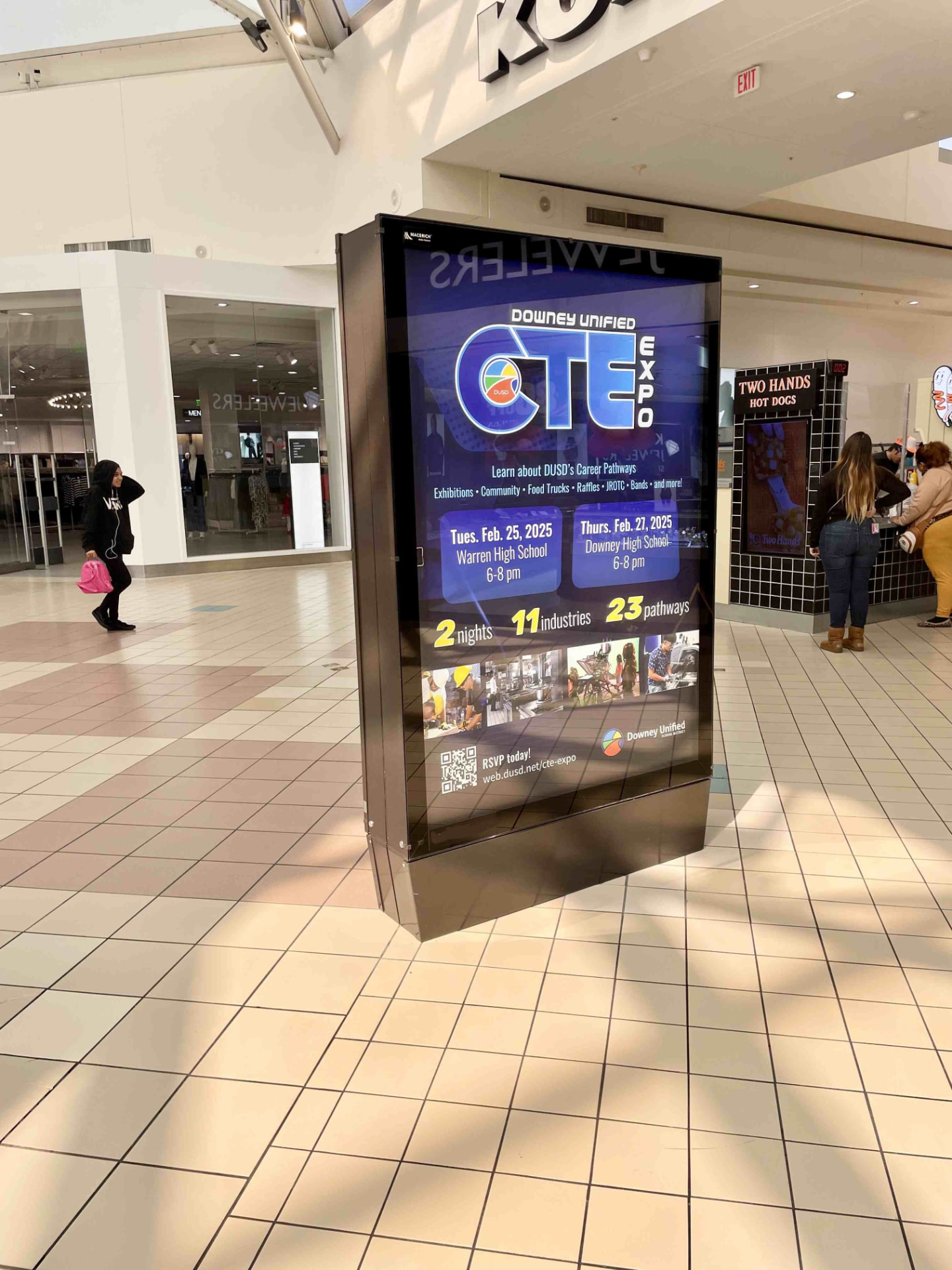
If your message needs more than a handful of words, put it on a backlit or a kiosk and use the floor to point toward it. Floors direct; panels explain. Campaigns that respect that division of labor consistently outperform those that try to make the floor do everything.
Frequently asked questions
Do floor graphics damage mall flooring?
Not when correctly specified and professionally removed. Properties mandate materials that lift cleanly.
How long do floor graphics last?
A properly laminated graphic holds up for a full flight in heavy traffic, and often longer in moderate traffic areas.
Can floor graphics be any shape?
Yes, contour cutting is standard, which makes shaped graphics such as footprints or arrows straightforward.
Are floor graphics good for small budgets?
They can be, especially as a supporting element that directs shoppers toward a store or event.
Sources
- ICSC shopping center industry research
- Out of Home Advertising Association of America
- National Retail Federation research
- Statista out of home advertising statistics
- FTC advertising and marketing rules
Related reading
Use this mall floor graphics guidance as a starting point, then ask MallAds.com to confirm current locations, formats, timing, and pricing for your campaign.