

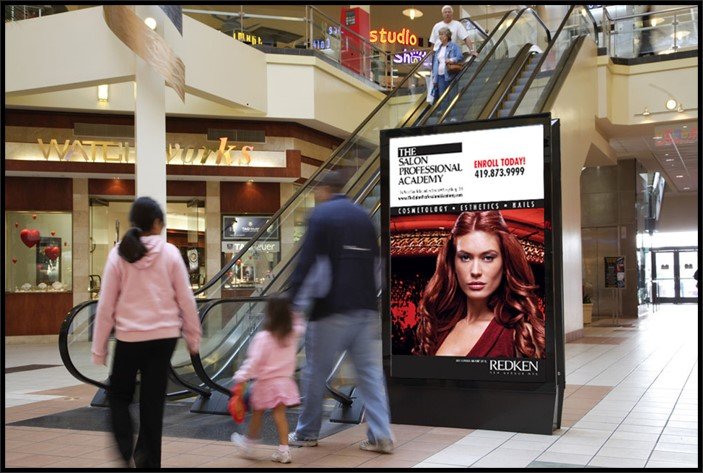
Backlit panels are the format that most looks like it belongs in the environment. Illuminated from behind, framed, and mounted at eye level along the shopper path, they read as part of the property rather than as an interruption, which is exactly why shoppers actually look at them.
Here is how backlits work, where they earn their premium, and what separates creative that glows from creative that just sits there.
What a backlit actually is
A backlit is a printed translucent graphic inside an illuminated frame. The light source behind the image makes colors saturate and keeps the panel legible regardless of ambient lighting conditions in the concourse, which is a meaningful advantage in centers with dim corridors or heavy skylight glare.
Because the frame is permanent and the graphic slides in and out, production costs are lower than for many formats and changeovers between flights are quick.
Where backlits perform best
The strongest positions are transitions: the walkway between an anchor and the main concourse, the approach to restrooms and family lounges, corridors leading to parking decks, and areas near seating where people pause.
- Anchor entrances where every visitor passes
- Corridors leading to parking structures and transit stops
- Near escalators and elevators where shoppers queue
- Adjacent to seating areas and family lounges
- Along the path to food courts and restrooms
Designing for an illuminated surface
Illuminated media rewards saturated color and punishes muddy midtones. Deep, rich backgrounds with bright type look striking; pale washes look washed out. Photographic images should be high resolution with strong subject separation, because backlighting flattens subtle contrast.
Keep the layout simple. A backlit is typically viewed from eight to fifteen feet for two to four seconds, which is enough for a brand, a proposition, and one action, and not enough for a paragraph.
Who uses backlits and why
Healthcare systems, financial institutions, universities, and consumer brands are the most frequent backlit buyers. All four sell something considered rather than impulsive, and the format's premium, permanent feel supports that kind of message.
Retail tenants inside the center also use backlits to pull traffic from other wings, which works well because the panel can point shoppers toward a specific location within the property.
Cost and commitment
Backlits price in the middle of the mall inventory range, above small posters and below spectaculars and digital networks. The graphic can usually run across multiple flights, so the effective cost falls the longer you stay up.
For a first campaign we typically recommend two panels in the same center at different points on the shopper loop, which produces repeat exposure within a single visit.
Measuring backlit performance
Use a dedicated landing page or phone number and ask customers where they heard about you. Because backlits build recognition over time rather than driving instant clicks, look at trends in branded search and inbound calls across the flight rather than day-by-day spikes.
Frequently asked questions
Are backlit panels always lit?
They are illuminated throughout mall operating hours, and in many centers the lighting runs beyond closing, extending visibility for evening traffic.
How quickly can the graphic be changed?
Faster than most formats. The frame stays; only the printed insert is swapped, usually overnight.
What resolution should artwork be?
Follow the property spec, but supply vector logos and type plus high-resolution imagery scaled to full size.
Do backlits work outside of malls?
Yes, the same technology appears in airports, transit stations, and street furniture, with similar design principles.
Sources
- Out of Home Advertising Association of America
- ICSC shopping center industry research
- Geopath OOH audience measurement
- Nielsen advertising research
- Statista out of home advertising statistics
Related reading
Use this backlit panel advertising guidance as a starting point, then ask MallAds.com to confirm current locations, formats, timing, and pricing for your campaign.