

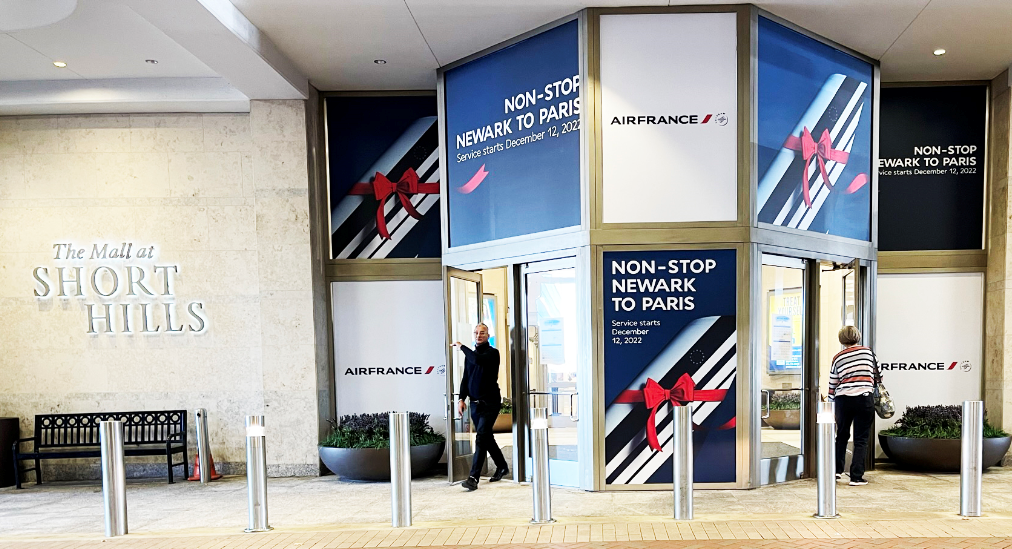
Airport advertising and mall advertising are both premium, high-dwell out-of-home formats, but they reach fundamentally different audiences with different needs. Confusing the two, or assuming one is simply a smaller version of the other, leads to wasted spend.
This comparison lays out who each audience actually is, what they respond to, and which businesses get the better return from each.
Who is in the audience
Airport audiences are travelers: business travelers moving through terminals on a schedule, leisure travelers with extended layover time, and a meaningful share of higher household income given the cost of air travel relative to other transportation. They are also, by definition, not local to the airport's immediate area.
Mall audiences are overwhelmingly local or regional residents, drawn from the surrounding trade area, visiting on a recurring basis for shopping, dining, and errands. They are far more likely to become repeat customers of a nearby business than an airport traveler passing through once.
Dwell time and mindset
Airport dwell time can be substantial, especially for travelers arriving early or facing a layover, and much of that time is spent waiting near a gate with limited distraction, which makes premium airport displays highly viewable.
Mall dwell time is typically shorter per visit but recurs weekly or monthly, and shoppers are actively engaged in browsing rather than waiting, which suits promotional and product messaging more directly than the brand-building tone that dominates airport creative.
What each format sells well
Airport advertising is well suited to categories with a national or luxury positioning: financial services, technology, travel-adjacent brands, and premium consumer goods, since the audience skews toward business and affluent leisure travelers regardless of home city.
- Airport: financial services, technology, luxury goods, travel and hospitality brands
- Airport: destination marketing and tourism boards for the arriving city
- Mall: local and regional retail, restaurants, healthcare, and services
- Mall: any business dependent on repeat local visits rather than a one-time traveler
Cost comparison
Airport advertising is typically priced at a premium relative to most other out-of-home formats, reflecting the captive high-income audience and limited inventory, particularly for large-format spectaculars near arrivals and baggage claim.
Mall advertising spans a wider price range, from modest kiosk and directory placements to large exterior spectaculars, giving local and regional advertisers more entry points at different budget levels than most airport programs allow.
Geographic logic
An airport reaches people who are, for the most part, not from the local area and will not be shopping locally afterward. That makes it a poor fit for a business whose customer needs to physically return to a specific location, and a strong fit for a national brand simply seeking premium exposure to travelers.
A mall reaches the exact opposite: people who live nearby and can act on the message that same week. For any business whose value depends on proximity, this difference outweighs almost every other factor in the comparison.
Combining airport and mall in a national plan
National brands with both retail distribution and a broader brand-building goal sometimes run both: airport placements in key hub cities for image and awareness among high-value travelers, and mall placements in markets with physical retail locations to drive local traffic and sales.
The two should be planned with different objectives and different creative, since asking a single execution to do both jobs usually weakens its performance in each.
Frequently asked questions
Is airport advertising worth it for a local business?
Rarely. Airport audiences are mostly travelers passing through, not local residents who can visit a physical location repeatedly.
Which is more expensive, airport or mall advertising?
Airport advertising generally carries a higher premium due to limited inventory and a captive high-income audience, while mall advertising offers a wider range of price points.
Do national retail brands use both formats?
Yes, often with different goals, airport for brand image among travelers and mall for local traffic in markets with stores.
What kind of business benefits most from airport advertising?
National or global brands, financial services, and travel-related businesses with no dependency on the traveler returning to that specific city.
Sources
- Out of Home Advertising Association of America
- Statista out of home advertising statistics
- DPAA digital out of home industry resources
- ICSC shopping center industry research
- National Retail Federation research
Related reading
Ready to apply these comparisons insights? MallAds.com brings more than 20 years of shopping-center and billboard experience to campaigns built around your market, audience, and budget.